Evidence at a Glance
Architecture and production coordination across a shared custom-engine codebase.
The repository records sustained engine and game-production development.
Spirit Ward began development under the working title Left Behind.
Overview
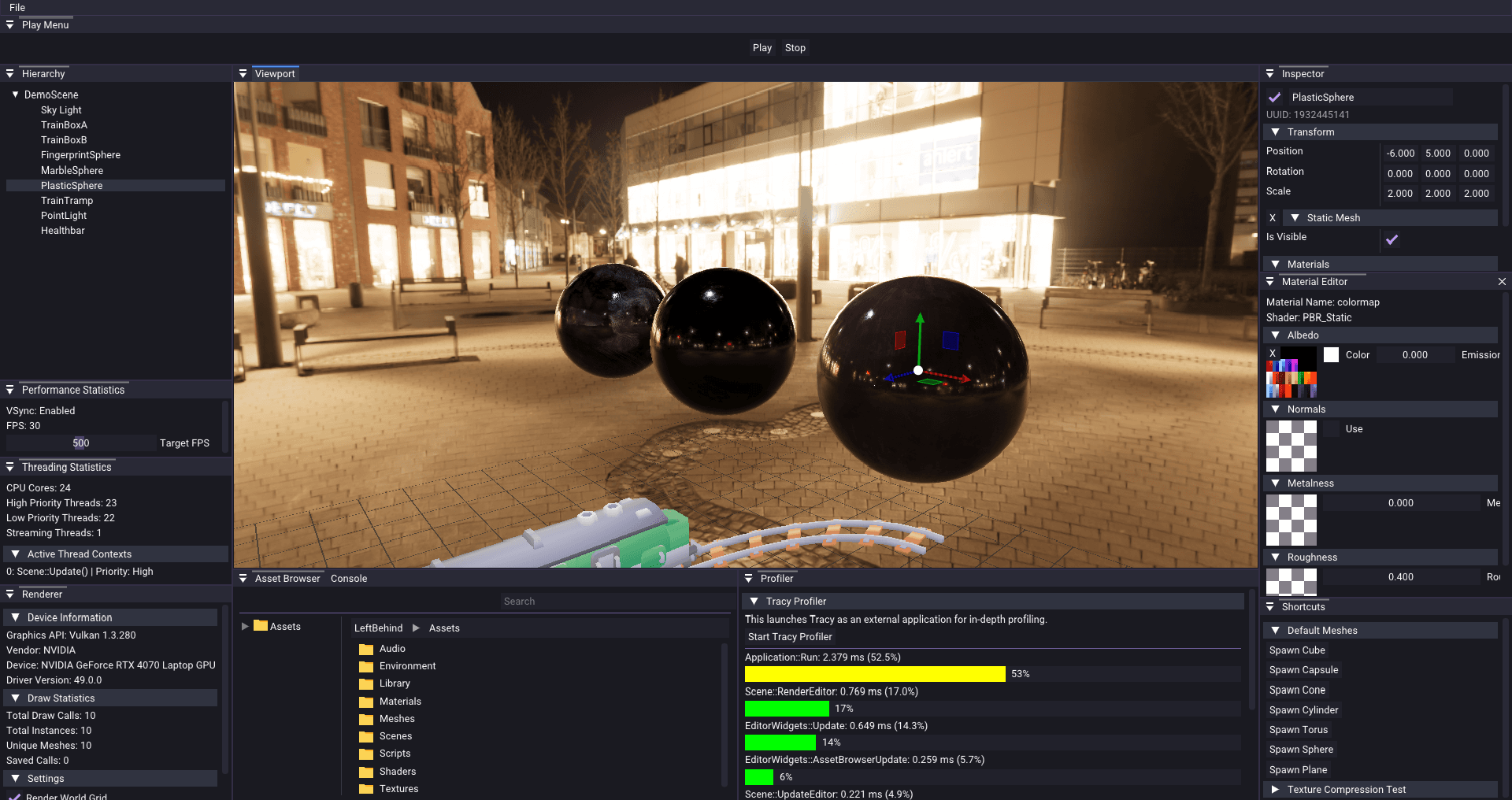
Nexus is a custom 3D engine developed alongside game production rather than as an isolated rendering exercise. Its public history spans the engine, runtime, C# scripting core, game installer, visualization tooling, and content for Spirit Ward, which began development under the working title Left Behind.
As technical lead, I coordinate a 12-engineer team while remaining hands-on with core architecture, resource management, Vulkan rendering, runtime/editor systems, and delivery automation. That dual role makes technical decisions answerable to both long-term engine quality and the immediate needs of designers and gameplay programmers.
The project is best understood as a production platform: engine systems, scripting, editor workflows, build pipelines, and the game consuming them have to evolve together without bringing the team to a halt.
The Challenge
Building an engine while a game depends on it removes the luxury of designing every subsystem in isolation. Requirements arrive through production, existing content must survive architectural change, and twelve engineers need clear ownership boundaries inside one evolving platform.
The engine also has to serve two very different audiences: low-level engineers need explicit control and debuggability, while gameplay and content teams need stable scripting, resources, editor workflows, and repeatable builds.
Key Engineering Decisions
Separate Engine, Runtime, and Managed Scripting
Distinct native engine, runtime, and Mono-based scripting layers keep gameplay iteration accessible without surrendering control of low-level systems.
Treat Tooling as Part of the Engine
Editor, visualization, resource, and installation workflows live beside runtime work because production throughput depends on all of them.
Build Around Vulkan and Explicit Resources
Rendering and resource ownership are designed for a modern explicit graphics pipeline instead of being hidden behind a general-purpose commercial engine.
Automate the Delivery Path
Premake and GitHub Actions support repeatable project generation, integration, and delivery while the team and game continue to change.
What I Owned
Results
Videos
Valuable Lessons
Engine architecture is ultimately a team-interface problem: ownership, workflows, and migration paths matter as much as subsystem design.
The strongest technical abstraction is one that survives contact with production without forcing every user to understand its internals.