Evidence at a Glance
Materials, meshes, shaders, resources, and render paths form a complete engine-facing pipeline.
C++ systems are paired with a C# scripting core.
Renderer, physics, profiler, resources, editor, and scripting code are publicly inspectable.
Overview
Aurora is a personal 3D engine created to study how production engines divide rendering, physics, resources, profiling, scripting, and editor concerns. It was influenced by the architectural discipline of Guerrilla's Decima Engine, while remaining an independent implementation and research codebase.
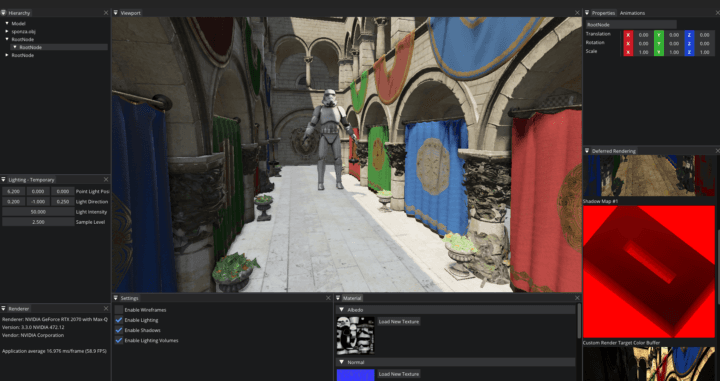
The public repository contains a PBR-oriented renderer, materials and mesh resources, shader compilation, physics integration and debug drawing, profiling infrastructure, editor contexts, asset importers, and a managed scripting core. The project is less about reproducing one commercial feature set than about learning where subsystem boundaries should sit.
Aurora became the architectural stepping stone for later team engines: it exposed the cost of broad personal R&D, the importance of usable tools, and the difference between implementing a subsystem and making it productive for someone else.
The Challenge
A general-purpose engine expands rapidly. Rendering, resources, physics, serialization, scripting, profiling, and tools all depend on one another, making weak boundaries increasingly expensive as the codebase grows.
The project also balanced exploration across graphics backends with the need to keep higher-level renderer and resource code coherent.
Key Engineering Decisions
Organize Around Explicit Engine Contexts
Subsystem contexts make lifetime, ownership, and cross-system access visible instead of hiding everything behind global state.
Separate Renderer Resources from Backend Work
Materials, meshes, shaders, and render paths sit above graphics-API-specific implementation so experiments do not rewrite the whole engine.
Treat Import and Profiling as Core Systems
Resource importers and instrumentation are part of the engine architecture because iteration and diagnosis depend on them.
Pair Native Systems with Managed Scripting
A C# layer explores faster gameplay iteration while native C++ retains authority over performance-sensitive systems.
What I Owned
Results
Valuable Lessons
Breadth creates learning, but a case study is clearer when it follows two or three architecture decisions deeply instead of listing every subsystem.
An engine feature is not complete until its debugging, import, and user workflow are considered alongside runtime code.